
Rough with the smooth
It's intertexturality....

You know how culture commentatary is constantly full of references to friction and frictionlessness? It probably comes from User Experience design (“UX”), i.e. mainly the craft of getting people to click on things, where it’s been big for a long, long time…. But just lately it’s everywhere, New York Times and everything…
I think perhaps the underlying thing here is about being awake to how friction and frictionlessness ARE already used in the structures that we inhabit - work, social media, marketing, culture, education, services, whatever - and how they CAN be used more purposefully and not just going along the paths set by whichever conglomerate is most interested in guiding us at any given time.
I really don’t want to be The Neurodivergence Guy, BUT being now, late in life, medicated for ADHD for the first time - i.e. having the biggest single source of friction in my life (having to think about 90 things at a time instead of one) removed - while at the same time dealing with my teenage kids’ experience and understanding exactly how far we’ve come collectively in understanding since I was at school is…. illuminating on this topic.
Talking to and reading so many different neurodiverse people brings home how much of coping mechanisms, workarounds and actual therapy consists of either “letting go” / “giving yourself permission” (i.e. removing friction), or deliberately putting friction / bumps in the road / complications / distractions into your processes, whether to keep you interested or engaged, snap you out of rote behaviour, get you back into a routine or whatever. Looked at this way it becomes less “friction good” or “friction bad” but “there is a whole toolkit here”.
It’s a toolkit, of course, that the developers at Meta and co already understand intimately, so one might even say that there’s something revolutionary about deciding to use it on yourself. As the Church of the SubGenius used to say: “PULL THE WOOL OVER YOUR OWN EYES”. Things are always difficult, but make them your own special kind of difficult.
Maybe this is really just what the NYT writer is saying in more tangled phrasing, but I don’t think it is. And in any case if we’re to get anywhere with this stuff it’s got to be by personalising it, taking it away from the “people are saying” or “the new things to do is…” vibe.
William Blake knew, 200 years ago: “DAMN BRACES, BLESS RELAXES”
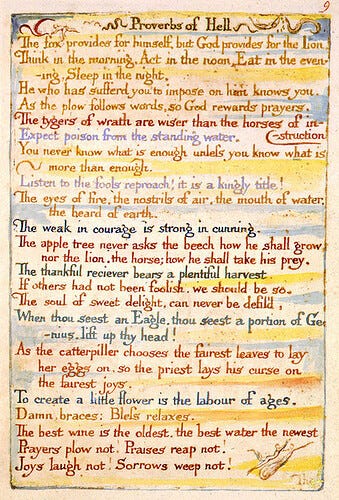
As this commentator puts it:
Damn and Bless here are held up as opposite sentiments. Damn is a word used when something bad happens and you need fortitude. You “damn” something, declaring it worth opposition, and brace your body to either overcome or escape it. Bless in this comparison would be the acknowledgement that you cannot control something and you should let it thrive on its own terms, the speaker relaxes as they disengage with the object of contention.
Pick your texture….